FSA / ESA
Compression Packing Technical ManualJoint industry guidance covering packing construction, selection, installation, adjustment, troubleshooting and application practice.
Pump packing, also called compression or gland packing, uses compressible rings around a rotating shaft or sleeve inside the stuffing box. Gland compression controls leakage—and in some services air ingress—while allowing rotation. Material, sizing, surface speed, equipment condition and adjustment determine heat, wear and packing life.

Braided packing, die-formed rings and application-specific packing sets used in pumps and other rotating equipment.
Graphite, PTFE, aramid, carbon and synthetic-fiber packings compared by temperature, surface speed and chemical compatibility.
Ring cutting, joint staggering, individual ring seating, gland adjustment, start-up checks and leakage control.
Packing cross-section, box depth, gland follower, lantern-ring position, flush connection and shaft or sleeve condition.
Diagnose excess leakage, high temperature, rapid wear, shaft or sleeve damage, vibration and short packing life.
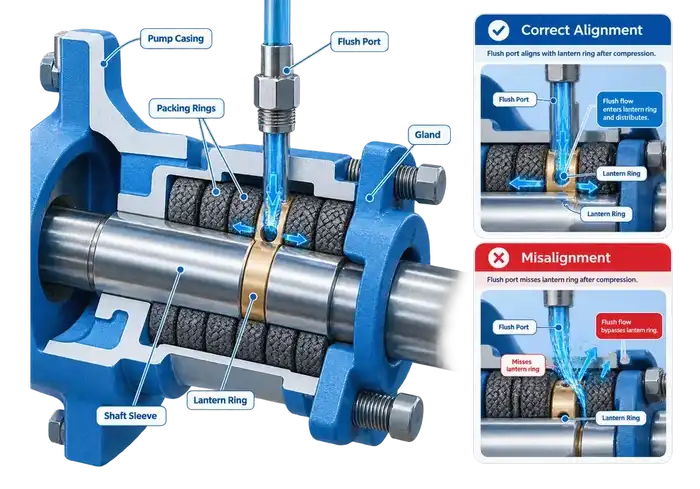
The gland follower applies axial compression to the packing rings. The rings deform and expand radially against the shaft or sleeve and the stuffing-box bore, creating a controlled restriction. In many pump services, a small amount of leakage or flush fluid lubricates and cools the shaft–packing interface. Unlike a mechanical seal, conventional pump packing uses a compressed ring set and is normally adjusted to the leakage required by the equipment and packing manufacturer.

SELECTION & APPLICATION
Compression packing—also known as pump packing, pump gland packing or gland packing—is a replaceable sealing system fitted in the stuffing box around a rotating shaft or shaft sleeve. Packing selection starts with the operating conditions: process fluid, stuffing-box pressure, temperature, shaft diameter, surface speed, solids, lubrication or flush conditions, and the mechanical condition of the shaft or sleeve. The packing material and construction must suit those conditions together.
Material families such as graphite, PTFE, carbon and aramid behave differently under heat, friction, chemical exposure and abrasive service. Chemical compatibility alone is not enough: a packing can suit the fluid yet run too hot at the required shaft speed. An abrasion-resistant construction can also wear a sleeve rapidly if it is too aggressive for the surface finish or if gland loading is excessive. Selection must account for the complete duty, not material name alone.
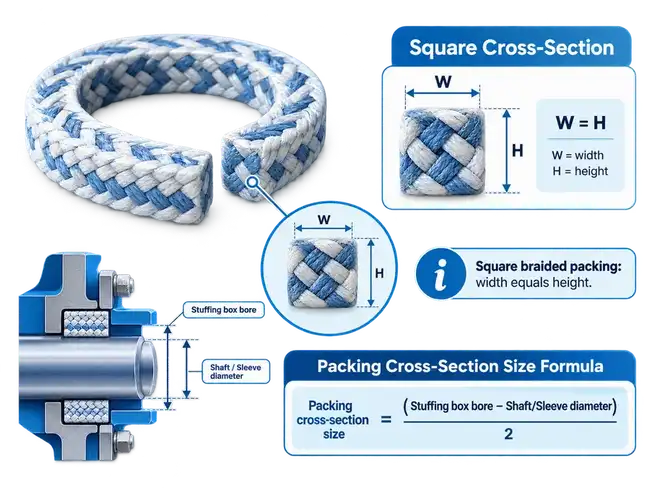
Stuffing-box geometry is equally important. For conventional square packing, nominal packing size is the radial gap: (stuffing-box bore − shaft or sleeve diameter) ÷ 2. Box depth determines the ring stack and the final position of a lantern ring when one is used. A correct material in the wrong cross-section, or a correctly sized packing set installed into a damaged or misaligned box, can still produce high leakage, heat and short service life.

There is no single standard covering every pump-packing application. Pump standards define equipment and service requirements; packing guidance covers material selection, installation and adjustment. Always apply the pump and packing manufacturers' limits.
Joint industry guidance covering packing construction, selection, installation, adjustment, troubleshooting and application practice.
Defines requirements for centrifugal pumps used in petroleum, petrochemical and natural-gas process services.
International requirements for centrifugal pumps used in petroleum, petrochemical and natural-gas process services.
Defines dimensional interchangeability requirements and selected design features for horizontal end-suction chemical-process pumps.

INSTALLATION & START-UP
Before installing compression packing, remove all old packing and inspect the stuffing box, gland follower, studs, flush connection and shaft or sleeve. Grooves, corrosion, excessive runout or a damaged sleeve surface can prevent a new packing set from bedding evenly. These defects should be corrected before repacking.
Packing rings are installed one at a time and seated individually. Ring joints are staggered so leakage does not have a direct path through the set. Where a lantern ring is part of the arrangement, its position has to be checked against the flush port after the packing has been compressed; the ring can move axially as the gland follower takes up the stack. The follower should enter the stuffing box squarely, and the shaft should still turn freely before start-up.
Initial adjustment is gradual. Gland nuts are tightened evenly and in small increments while leakage and temperature are observed. Conventional pump packing commonly relies on some leakage or supplied flush fluid for lubrication and heat removal, so an immediate attempt to force leakage to zero can over-compress the set, raise friction and damage the packing or shaft sleeve. Final leakage, flush pressure and temperature limits are application-specific and should follow the pump and packing manufacturers' instructions. Persistent leakage, overheating or rapid wear should be diagnosed before further tightening.
V = Surface speed (m/s)
D = Shaft diameter (m)
N = Rotational speed (rpm)